Summer is ebbing. The great seasonal triangle of Vega, Deneb and Altair opens the night higher and higher in the sky and soon will at zenith by 10pm. That means that I soon won't be able to image targets in Cygnus, since they are slowly slipping behind the house and out of my -- way too limited -- field of view.
So, before that happens, I figured it was time to capture the glories of The Veil Nebula. This sweeping collection of filamentary wisps of nebulosity is all that remains of a massive star that went supernova between 7,000 and 10,000 years ago. The Veil covers a considerable amount of sky and its constituent components include NGC 6992, NGC 6995 and NGC 6960.
The Veil is particularly strong in hydrogen and oxygen, which makes it an excellent target for narrowband imaging. The following images were taken using the Ha and OIII filters, combined to create bicolor images with a HOO profile.
Spread out over so large an area, the Veil is impossible to fit into one image, even with the Evostar 72ED's quite wide FOV. Thus, I imaged the nebula in two parts: the Eastern Veil, including NGC 6992 and then the Western Veil, including NGC 6960. Late August weather hasn't been kind to sky watchers here in New York, but I managed to get four nights over the past two weeks, spending two nights on each image.
The two resulting images were then combined in Pixinsight to create a single image that captures most, though not all, of the Veil Nebula complex.
The Western Veil, including NGC 6960:
Captured on two nights in mid August. The below image is composed of 88, 180-second sub-exposures - 44 shot through the Ha filter and 44 through the OIII filter. The image nicely captures Pickering's Triangle, the expanse of twisting, gossamer filaments to the right edge of the image.
The Eastern Veil, including NGC 6992
This portion of the Veil is a favorite target for imagers. I have shot it before with both the DSLR and the SSP -- and I think I managed to capture parts of it years ago with the Meade DSI. But the ASI1600 does it particular justice. This image was captured over two nights and is composed of 78, 180-second sub-exposures, including 42 shot through the Ha filter and 36 through the OIII filter.
The Veil Nebula Complete (well, mostly)
With both the Western and Eastern sections captured, I used dnaLinearFit, Star Alignment and GradientMergeMosaic in Pixinsight to combine the two images and produce the below mosaic, which captures the majority of the nebula complex. Some nebulosity was clipped at the top and bottom of the image, which leaves me something to target next year.
I am very pleased with both panels and the final combined mosaic. It is a nice way to see summer come to its end.
The history of astronomy is a history of receding horizons -- Edwin Hubble
Sunday, August 25, 2019
Monday, August 19, 2019
Summer 2019 - Major Upgrades
New Mount, New Camera, New Images
In December 2018, my old Meade LXD75 mount suffered a total R.A. motor failure. After a decade of far better service than I should have expected -- the LXD line was not Meade's best or most accurate equatorial mount -- it was time to move on. After considerable research, I settled on the Sky Watcher EQ6-R Pro, which I ordered through Highpoint Scientific.
The new mount quickly proved far more capable and reliable than the LXD, which was not unexpected. Since I had upgraded the mount, I decided it was time to do likewise with the camera. I had been using a Gary Honis-full spectrum modified Canon EOS T2i since 2014 and had reached its limits. After more research, I settled on a ZWO ASI1600MM Pro. This was a major change from the one-shot-color (OSC) imaging that I had been doing for years. But a switch to Mono (a monochrome chip), seemed like the next step in my imaging development. So I took the plunge. Since I still wanted to capture color images, and because I was interested in using Narrowband filters, I selected the ASI1600MM Pro kit with an electronic filter wheel and 31mm L, R, G, B, Ha, OIII and SII filters.
Naturally, once the new camera arrived in early April, six weeks of clouds and rain followed. During that time, I decide that, having spent money on a new mount and camera, I might as well purchase a new scope to go with them. I had grown a little tired of constantly collimating my 6" Orion Newtonian Astrograph, so I purchased a Sky Watcher Evostar 72 ED, a 72mm doublet refractor, which promised a very wide field of view. With the added .8 field flattener/reducer that already wide field was widened even more.
Having indulged myself with a new mount, camera and telescope, I decided to spend even more money. I purchased Pixinsight, the leading astro-imaging processing software and took a subscription to Photoshop. At this point, why not?
Between the software and camera, there was an inevitable learning curve, but by June, I was amazing myself with images that far better matched what I had long hoped to achieve in astro-imaging. The ASI1600 has proven extremely versatile and sensitive, allowing me to capture objects that were just too faint for the DSLR (and SSP before it). I had long avoiding Mono imaging because I figured it would be too difficult. However, the reality is that with contemporary electronic filter wheels and software (I use Astrophotography Tool - APT), the process is relatively simple. There are a few more steps, but not many, and the results amply justify the extra effort.
So, here are some of the highlights of the last eight weeks, through mid August.
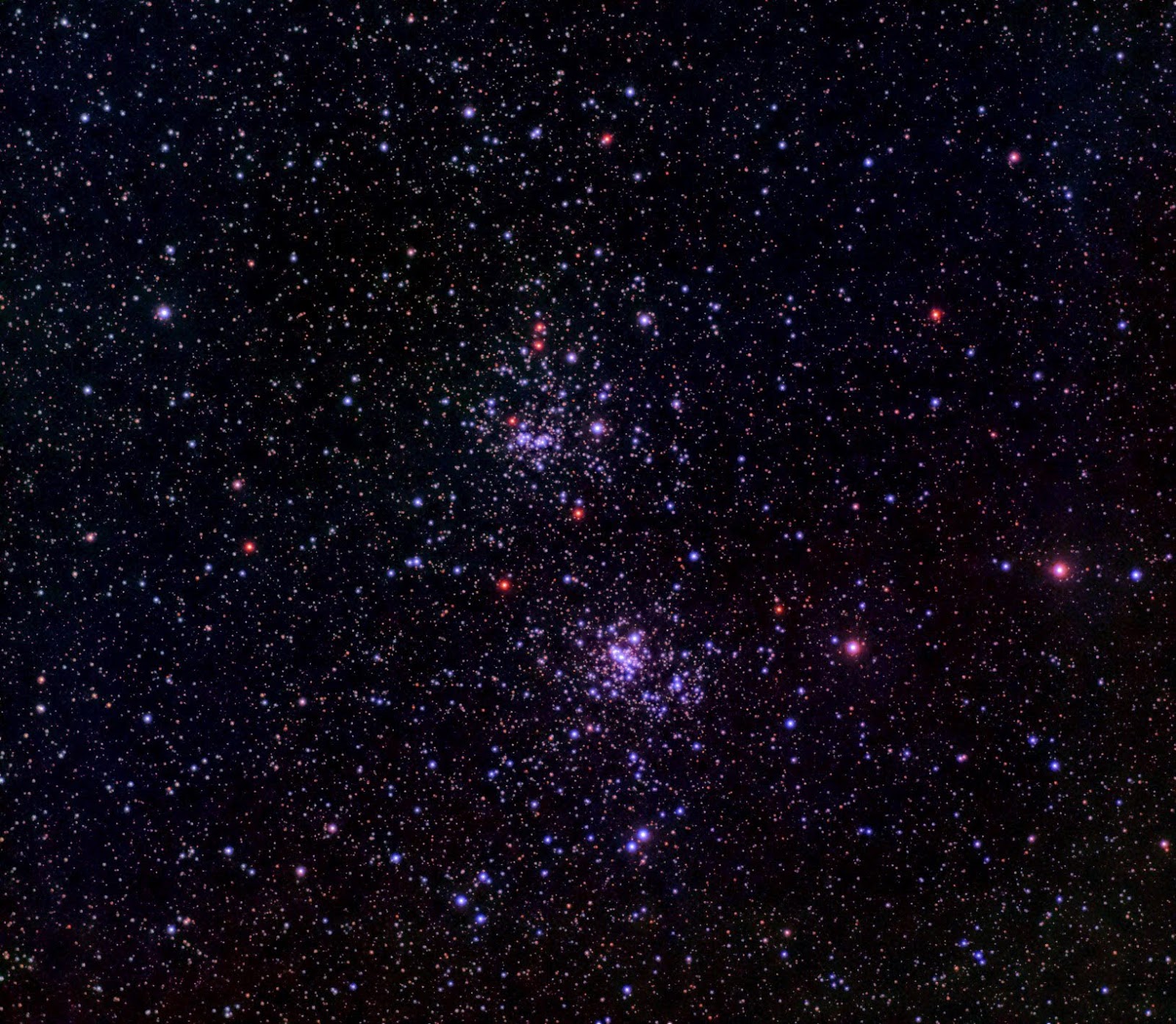
NGC 884 & 869 - The Double Cluster
A preview of fall's coming attractions. Less than 20 minutes of exposure through RGB.
M8, M20 and NGC 6559
I am particularly pleased with this image, which captures M20, the Trifid Nebula (upper middle/right), M8, the Lagoon Nebula (lower right) and NGC 6559 (lower left), in one image. More so, because this is actually two images that Pixinsight combined into a mosaic. The 72ED's FOV is generous enough the capture M8 and M20 in one shot, but not all three objects.
M11 - The Wild Dust Cluster
Under 20 minutes of RGB exposure time, but enough to bring out the dense starfield and wispy dark nebula in the region around the cluster.
M27 - The Dumbbell Nebula
This image is one of my first Narrowband images, a combination of Ha and OIII subs.
M31 - The Andromeda Galaxy
Another preview of fall. This image is composed of just over 30 minutes of 60-second RGB subs, which shows the considerable power of the ASI1600.
NGC7635, M52 & Friends
This image truly brought home the power of mono imaging and the sensitivity of the ASI1600. I have been imaging the beautiful cluster M52 (top/center) and NGC 7635, the Bubble Nebula (mid center/left), and NGC 7538 (lower center/right) for years, completely unaware of the other objects - Sh2-157 (the Lobster Claw - lower left) and extended nebulosity between NGC 7635 and NGC 7538 (mid to lower right). The DSLR was simply not sensitive enough to capture them.
NGC 7000 and NGC 5070
This mosaic of two images capturing the North American Nebula (NGC 7000) and the Pelican Nebula (NGC 5070) puts just about every astro-image I'd taken before to shame. This image is under an hour of HaRBG integration, with subs of just 60 seconds.
NGC7023 - Iris Nebula
Notoriously difficult to bring out the dust clouds surrounding the Iris, but at just 5 hours of RGB integration, the ASI1600 does a good job.
NGC7293 - The Double Helix Nebula
Just under eight hours of Ha and OIII, with subs ranging from 600 seconds to 180 seconds.
NGC7822
A region of emission nebula and star clusters in Cepheus.
Sh2-101 - The Tulip Nebula
About an hour RGB integration in Cygnus.
Sh2-157 - The Lobster Claw
Spotted whilst imaging the Bubble Nebula (NGC 7635 - upper center/right), the Lobster Claw demanded its own image. About two hours of integration in RGB using 300-second subs.
Tuesday, September 26, 2017
September 2017
Summer's humidity and haze still lingers despite the calendar, but there have been a solid number of good nights this month. The following images were taken with the new Orion 6" f/4 Astrograph (with a GSO Coma Corrector) and the modified T2i camera.
NGC 6992
The most prominent segment of the eastern side of the Veil Nebula, this supernova remnant, stretches for 90 light years or more and is about 1,500 to 1,900 light years distant.
This image comprises 61, 60-second sub-exposures for just over an hour of total exposure.
NGC6960
The western segment of the Veil, and possibly it's most beautiful and ephemeral slice as a major filament appears to pass near a relatively bright star.
This image comprises 66, 60-second sub-exposures for a total exposure time of one hour and six minutes.
M31 - The Andromeda Galaxy
One of the most famous objects in the night sky and visible to the naked eye. Located about 2.5 million light years away and possibly twice the size of our own Milky Way galaxy, containing as many as a trillion stars.
This image comprises 79, 60-second sub-exposures for almost an hour and twenty minutes of total exposure time.
M33 - The Triangulum
Relatively bright, but notoriously difficult to image, this galaxy appears in Triangulum, near Aries and Pegasus and visually not far from M31. The galaxy is actually 2.3 million to 3.1 million light years away and is part of the Local Group along with the Milky Way and M31, but is the smaller of the three at just 60,000 light years across and containing perhaps 40 billion stars.
This image is composed of 25, 300-second sub-exposures for a total exposure time of two hours and five minutes.
NGC7830
Sometimes referred to as the Wizard Nebula, this emission nebula surround a small cluster of stars was first identified by Caroline Herschel in 1787. It is about 7,000 light years distant and appears in the constellation Cepheus.
This image comprises 22, 300-second sub-exposures for a total exposure time of two hours and fifty minutes.
Tuesday, April 18, 2017
April 17, 2017
Only two good nights so far this April. Still, I did manage to squeeze in some imaging.
M57 - The Ring Nebula
A preview of summer's attractions. The Ring is easily visible in small telescopes in the constellation Lyra. Formed as a dying star expelled gas, this planetary nebula is located about 2,300 light years away. Larger scopes can show the white dwarf star at its center.
This image comprises just 44 30-second subs taken with the T2i through the 8" Schmidt-Cassegrain for a total exposure time of 22 minutes.
M51 - The Whirlpool Galaxy
Appearing close to the Big Dipper, but actually inside the boundary of the constellation of Canes Venatici (the Hunting Dogs), this was the first spiral galaxy to be so classed. It is actually two galaxies: a large spiral interacting with an Seyfert galaxy nucleus. M51 is estimated to be about 23 million light years distant.
This image comprises 196 30-second subs taken on April 8 and April 14 taken with the T2i through the 8" Schmidt-Cassegrain at f/10 for a total exposure time of 98 minutes.
M13 - Globular Cluster in Hercules
Considered the brightest globular cluster in the northern sky, M13 is easily seen in binoculars and small telescopes, though larger apertures are need to resolve its stars. Several hundred thousand stars are packed into a ball about 145 light years in diameter. M13 is estimated to be more than 25,000 light years distant.
This image is comprised of 37 30-second subs taken with the T2i through the 8" Schmidt-Cassegrain at f/10 for a total exposure time of 18 minutes and 30 seconds.
Winter 2016-2017
Moving toward using the modified T2i as the primary imaging camera. This comes largely after figuring out how to take flats properly using BackyardEOS, which makes the resulting images much more satisfying.
M97 - The Owl Nebula
The famed planetary nebula in Ursa Major, first identified in 1781. Located just over 2,000 light years away.
This image comprises 184 30-second sub-exposures taken with the T2i through the 8" Schmidt-Cassegrain at f/10. Total exposure time: 92 minutes.
M81 - Spiral Galaxy in Ursa Major
Located about 12 million light years away. Generally considered one of the finest spiral galaxies for observing
This image was made from 162 30-second sub-exposures with the T2i through the 8: Schmidt-Cassegrain. Total exposure time: 81 minutes. Would have liked to get more exposure time on this object, but the weather was not compliant.
M109 -- Spiral Galaxy in Ursa Major
Another splendid spiral in the Big Dipper. Estimated to be about 83 million light years distant.
M97 - The Owl Nebula
The famed planetary nebula in Ursa Major, first identified in 1781. Located just over 2,000 light years away.
This image comprises 184 30-second sub-exposures taken with the T2i through the 8" Schmidt-Cassegrain at f/10. Total exposure time: 92 minutes.
M81 - Spiral Galaxy in Ursa Major
Located about 12 million light years away. Generally considered one of the finest spiral galaxies for observing
This image was made from 162 30-second sub-exposures with the T2i through the 8: Schmidt-Cassegrain. Total exposure time: 81 minutes. Would have liked to get more exposure time on this object, but the weather was not compliant.
M109 -- Spiral Galaxy in Ursa Major
Another splendid spiral in the Big Dipper. Estimated to be about 83 million light years distant.
This image was created from 117 30-second sub-exposures taken with the T2i through the 8" Schmidt-Cassegrain at f/10 for a total exposure time of 58 minutes and 30 seconds. Much more exposure time is needed to draw out details, but the weather did not afford many clear nights this winter.
Thursday, April 16, 2015
April 15, 2015 - Galaxies, a Globular Cluster and the Dumbbell
The weather over Westchester County has not been especially conducive to astronomy these last several weeks. Too many cloudy nights, or clear nights dominated by a too-bright moon. Still, this is the best time to look beyond the Milky Way and see the galaxies that are scattered like gems so very far away.
M13
Actually, we'll start with something much closer to home. The famed Hercules Globular Cluster, a great ball composed of several hundred thousand stars packed close together. Located about 22,000 light years away, M13 is part of the Milky Way and is easily visible through binoculars or small telescopes. The cluster can sometimes be detected as a fuzzy patch with the naked eye -- about a third of the way between the stars Eta and Zeta Herculis, if viewed from a very dark location away from city lights.
The English polymath Edmond Halley first noted the cluster in 1714; French comet-hunter Charles Messier added it to his famous list of fuzzy objects in 1764.
This image was composed with 15, 120-second sub-exposures for a total exposure time of 30 minutes. It was taken through the 8" Schmidt-Cassegrain at f/10. All images in this post were captured with the Starshoot Pro camera.
M27 -- The Dumbbell Nebula
One more local attraction before we leave the Milky Way. Though this nebula is definitely a resident of the summer sky -- appearing in the constellation Vulpecula -- it had risen high enough at the end of my last imaging session to get a preview.
Born when an aging star blew off its outer layers, M27 is a planetary nebula. The star that gave it birth survives as a much-shrunken white dwarf at its center. The nebula is thought to be less than 15,000 years old and is located more than 1,300 light years away. It is easily visible in binoculars or a small telescopes as a faint greenish-white cloud having the apparent shape of a dumbbell or hourglass -- hence it's common name.
This image was taken through the 8" Schmidt-Cassegrain at f/10 and comprised of 24, 120-second subs, for a total exposure time of 48 minutes.
M88
And now we move outside of the Milky Way ... indeed, a very long way outside it. M88 is a spiral galaxy that appears in the constellation Coma Berenices. Part of the Virgo Cluster of galaxies, it is estimated to be about 55 million light years distant. The galaxy is seen at about a 64-degree angle.
I didn't get as many subs as I wanted for this image, so I will have to return to M88 again before summer arrives. 23, 120-second subs taken through the 8" Schmidt-Cassegrain at f/10 were combined to create this 46-minute exposure.
M101
This is a large spiral galaxy, seen face-on, that appears in the constellation Ursa Major. With a disk roughly 170,000 light years in diameter, M101 is home to more than 100 billion stars. It is located around 20 million light years away and is sometimes called the Pinwheel Galaxy. It is faintly visible in small and medium-sized telescopes under dark skies.
This image is composed from 55, 120-second subs taken through the 8" Schmidt-Cassegrain at f/10 over two nights earlier this month. Total exposure time on this image is just under 2 hours, but at least another hour will be needed to draw out detail in the spiral arms.
M109
Also appearing in Ursa Major, M109 is a barred-spiral galaxy. The galaxy is estimated to be between 60 and 84 million light years away and is part of a group of about 50 galaxies.
40, 120-second subs taken through the 8" Schmidt-Cassegrain at f/10 were combined to create this 80-minute exposure.
M13
Actually, we'll start with something much closer to home. The famed Hercules Globular Cluster, a great ball composed of several hundred thousand stars packed close together. Located about 22,000 light years away, M13 is part of the Milky Way and is easily visible through binoculars or small telescopes. The cluster can sometimes be detected as a fuzzy patch with the naked eye -- about a third of the way between the stars Eta and Zeta Herculis, if viewed from a very dark location away from city lights.
The English polymath Edmond Halley first noted the cluster in 1714; French comet-hunter Charles Messier added it to his famous list of fuzzy objects in 1764.
This image was composed with 15, 120-second sub-exposures for a total exposure time of 30 minutes. It was taken through the 8" Schmidt-Cassegrain at f/10. All images in this post were captured with the Starshoot Pro camera.
M27 -- The Dumbbell Nebula
One more local attraction before we leave the Milky Way. Though this nebula is definitely a resident of the summer sky -- appearing in the constellation Vulpecula -- it had risen high enough at the end of my last imaging session to get a preview.
Born when an aging star blew off its outer layers, M27 is a planetary nebula. The star that gave it birth survives as a much-shrunken white dwarf at its center. The nebula is thought to be less than 15,000 years old and is located more than 1,300 light years away. It is easily visible in binoculars or a small telescopes as a faint greenish-white cloud having the apparent shape of a dumbbell or hourglass -- hence it's common name.
This image was taken through the 8" Schmidt-Cassegrain at f/10 and comprised of 24, 120-second subs, for a total exposure time of 48 minutes.
M88
And now we move outside of the Milky Way ... indeed, a very long way outside it. M88 is a spiral galaxy that appears in the constellation Coma Berenices. Part of the Virgo Cluster of galaxies, it is estimated to be about 55 million light years distant. The galaxy is seen at about a 64-degree angle.
I didn't get as many subs as I wanted for this image, so I will have to return to M88 again before summer arrives. 23, 120-second subs taken through the 8" Schmidt-Cassegrain at f/10 were combined to create this 46-minute exposure.
M101
This is a large spiral galaxy, seen face-on, that appears in the constellation Ursa Major. With a disk roughly 170,000 light years in diameter, M101 is home to more than 100 billion stars. It is located around 20 million light years away and is sometimes called the Pinwheel Galaxy. It is faintly visible in small and medium-sized telescopes under dark skies.
This image is composed from 55, 120-second subs taken through the 8" Schmidt-Cassegrain at f/10 over two nights earlier this month. Total exposure time on this image is just under 2 hours, but at least another hour will be needed to draw out detail in the spiral arms.
M109
Also appearing in Ursa Major, M109 is a barred-spiral galaxy. The galaxy is estimated to be between 60 and 84 million light years away and is part of a group of about 50 galaxies.
40, 120-second subs taken through the 8" Schmidt-Cassegrain at f/10 were combined to create this 80-minute exposure.
Sunday, March 15, 2015
March 15, 2015 - Spring Spirals
Spring is in the air and the night sky is filled with galaxies.
M51 - The Whirlpool Galaxy
First noted by French astronomer Charles Messier in 1773, this "nebula's" spiral structure wouldn't be detected until the Earl of Rosse observed it in 1845. Today, we know that this "spiral nebula" is in fact a vast conglomeration of billions of stars, gas and dust, a galaxy, located roughly 23 million light years distant in the spring constellation Canes Venatici.
This is undoubtedly the best image of M51 that I have taken so far, and it is the first I've shot at f/10 though the 8" Schmidt-Cassegrain. The image is composed of 53, 120-second sub-exposures, taken on the night of March 12, for a total exposure time of 106 minutes. It is my intention to acquire several more hours of exposure time for M51 over the coming weeks.
M65, M66 & NGC3628
Three galaxies in the same field of view. M65, which appears at the top of the image is about 35 million light years away, while M66, on the right edge of the image, is about 36 million light years away. NGC3628, located about 35 million light years away, is at the lower left edge of the image. All three -- known as the Leo Triplet -- are spiral galaxies and appear in the constellation Leo.
M65 and M66 were discovered by Charles Messier around 1780, while NGC3628 was first noted by William Herschel in 1784.
This image comprises 23, 120-second sub-exposures taken through the 8" Schmidt-Cassegrain at f/6.3 on the night of March 11, for a total exposure time of 46 minutes.
NGC2903
First noted by William Herschel in 1784, NGC2903 is a relatively bright barred-spiral galaxy located about 30 million light years away, appearing in the constellation of Leo.
The above image was composed from 25, 120-second images, taken through the 8" Schmidt-Cassegrain at f/10 on the night of March 12.
M3
This ancient globular cluster is thought to contain about half a million stars. It's age has been estimated at eight billion years. Charles Messier first noted it in 1764. Almost 34,000 light years away, it appears in the constellation Canes Venatici.
Subscribe to:
Posts (Atom)